Report: Wagner Group Moved an Estimated $2.5 Billion in African Gold to Russia Despite Sanctions
A new study says the Wagner mercenary group has laundered gold mined in Sudan, Mali and the Central African Republic to help finance Russia's war on Ukraine.
By Amy Swan ·
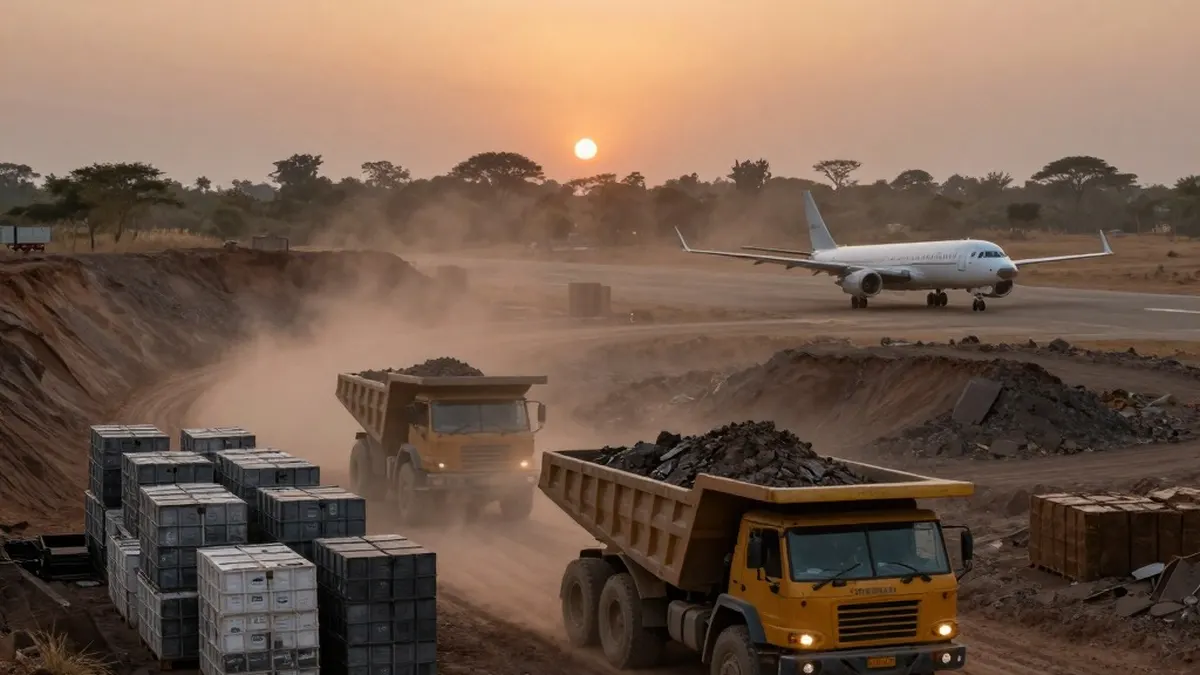
A new report alleges that the Wagner mercenary group has channeled about $2.5 billion to Russia through gold mining operations in Africa since Moscow launched its full-scale invasion of Ukraine last year. The money, according to the study, has helped support the Russian war effort even as global sanctions have cut the country's economy off from much of the world.
"The Blood Gold Report" was produced by the Consumer Choice Center and 21Democracy, a nonprofit that tracks corruption and advocates for government transparency. Political analyst Jessica Berlin, one of its co-authors, discussed the findings with NPR's Scott Detrow on All Things Considered.
The report concentrates on Sudan, Mali and the Central African Republic. Berlin said these are the countries where Russia's gold trade has grown the most, and that they are the main targets of its activity in the industry. They also show, she said, how Wagner works across the continent and builds its economic and political influence.
Berlin explained that the authors use the term "blood gold" for gold that is mined and laundered into international markets to finance the Russian state. In her telling, that money lets the Kremlin wage its war against Ukraine and commit atrocities against people in Syria and elsewhere in Africa. She argued there is no separation between Wagner, which describes itself as a private military contractor, and the Kremlin's wars. "If you enable one, you're enabling the other," she said in summarizing the point.
Wagner's role in Africa predates the invasion of Ukraine, Berlin noted. In the Central African Republic, the group has worked with the government since 2017 and was given what amounts to exclusive rights to the country's largest gold mine in exchange for propping up the regime. She described Wagner as acting like a private security firm that provides physical and political protection, targeting opposition groups and using disinformation and hybrid warfare tactics against critics.
As for how the gold reaches the market, Berlin said much of it is sold, smuggled and refined through the Middle East, particularly the United Arab Emirates and the Dubai gold market, as well as through China and Hong Kong. Extensive networks of front and shell companies are used to move the money. The gold itself travels by truck and plane, and once melted down it can be mixed with legally sourced gold, which makes it relatively easy to conceal. In Mali, she said, that step is unnecessary because Wagner is effectively paid in cash from the state taxes that legitimate Western mining companies pay on their operations there.
On the effect of sanctions, Berlin offered a mixed assessment. Measures aimed at Wagner and people in its orbit are working, she said, and it has become harder for the group to get its money out of Africa. But she called $2.5 billion over roughly a year and a half an enormous sum and said the current response falls short.
Berlin urged much heavier sanctions that go beyond Wagner's supply side to target the governments that hire the group. If officials in Africa and elsewhere knew that doing business with Wagner would cost them and their families personally, through financial penalties and travel restrictions, she said, they might "think twice" about signing contracts. That, she argued, would make such deals less attractive and less profitable.
A correction later appended to the NPR story noted that the report was produced with 21Democracy, not Democracy 21, which is a different organization.
Source: LAist